
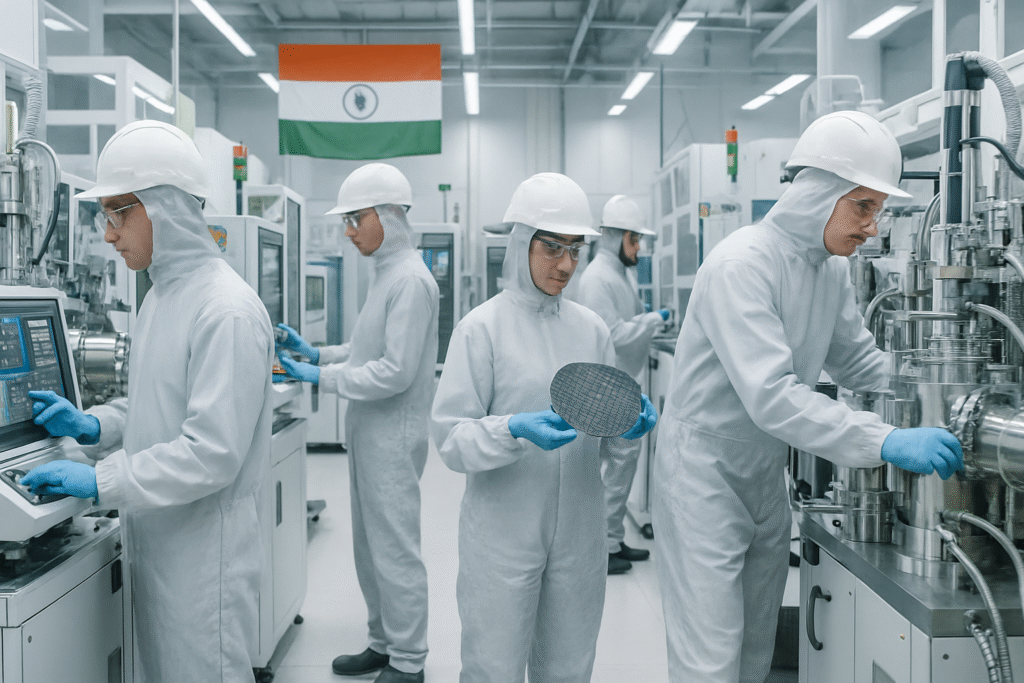
India’s Semiconductor Revolution: Poised to Capture Big Share of $1 Trillion Global Market
India’s Increasing Role in the Global Chip Market
The world today runs on microchips, those tiny but mighty slices of silicon that power everything from smartphones and cars to cloud servers and AI robots. As the world’s hunger for chips continues to grow, India—already a digital superpower—is rapidly stepping up to become a major player in the global semiconductor industry. Here’s how India is making waves, and what this means for the future of technology.
India’s Semiconductor Revolution
Until recently, the world’s chip production was dominated by countries like Taiwan, South Korea, the US, Japan, and China. Taiwan’s TSMC leads the pack, making over half of the world’s advanced semiconductors. But geopolitical tensions and disruptions during COVID-19 showed the risks of depending on just a few countries for such a vital technology.
India, home to one-sixth of humanity and a booming tech talent pool, decided to seize the opportunity. In 2021, the Indian government launched a bold $10 billion “Semiconductor Mission,” offering subsidies and incentives to start local chip design and manufacturing. Fast-forward to 2025, and the progress is visible: Indian factories are rolling out the first “made-in-India” chips, like the Vikram processor developed by ISRO’s Semiconductor Lab and other private players.
The creation of five new chip plants, heavy investments from leading global companies, and the successful hosting of “Semicon India 2025” cement India’s status as a growing hub. International companies like ASML now want to be part of India’s chip story, fueling innovation, employment, and new research across the country.
Chips Matter in today’s AI, Tech & Automation Industries
Chips are the brains inside every modern gadget. They also enable advances in artificial intelligence, autonomous vehicles, green energy, and medical devices. Having a robust domestic chip ecosystem makes India more self-reliant and able to compete in a high-stakes global industry.
Semiconductors weren’t invented by one person, but William Shockley, John Bardeen, and Walter Brattain invented the first working transistor at Bell Labs in 1947, setting the stage for modern chips.
India’s Bright Future in Chips
By creating its own chips, India is aiming to shorten supply chains, reduce costs, and boost sectors like telecom, automotive, defense, and consumer electronics. The government’s commitment, proven by billions in incentives and collaborative research, is showing results: local start-ups, students, and scientists are entering the global value chain.
Experts predict India’s chip market could cross $100 billion by 2030. As the rest of the world takes notice, India is emerging not just as a consumer but as an innovator and producer—clear evidence of its rising influence.

India’s growing chip industry is a national priority, not just a business bet. By investing in semiconductors, building local talent, and attracting partners, India is joining the ranks of global tech leaders—and helping ensure more stable, secure, and innovative electronics for the entire world.
Reinforcing Hon’ble PM @narendramodi's vision for #IndiaTechade, GoI grants first approval under ₹76K Cr. #SemiconIndiaProgramme to @MicronTech’s $2.75Bn (₹ 22,516 Cr.) Semiconductor facility proposal. pic.twitter.com/Nlxn9KH7dm
— India Semiconductor Mission (@SemiconIndia) June 22, 2023
What is the world’s largest chip?
The world’s largest chip is the Cerebras Wafer-Scale Engine (WSE), an 8.5-inch square chip built for AI tasks. It features 4 trillion transistors and can outpace traditional chips for large-scale AI work.
Which country is no. 1 in semiconductors?
Taiwan is the global leader, with Taiwan Semiconductor Manufacturing Company (TSMC) controlling over 60% of worldwide chip output and nearly all advanced chip production.
Is India making semiconductors?
Yes! As of 2025, India is manufacturing its own chips. Facilities like ISRO’s SCL and new fabrication plants are producing homegrown processors, with massive government support driving the “India Semiconductor Mission”.
Which is the most powerful chip?
As of 2025, TSMC unveiled the world’s most advanced 2-nanometer microchip. For AI, the Cerebras WSE is the largest, and NVIDIA’s Blackwell Ultra is one of the most powerful for AI workloads.
What is the best AI chip?
NVIDIA leads the pack with its AI chips, especially the Blackwell series and the edge-focused Jetson AGX Orin, offering record-breaking AI performance.
Who is the world’s largest memory chipmaker?
In 2025, SK hynix of South Korea overtook Samsung to become the world’s top memory chipmaker, leading in high-bandwidth memory critical for AI processors.
Who makes chips for NVIDIA?
NVIDIA designs its chips but outsources manufacturing mainly to TSMC in Taiwan, known for its advanced process technology.
Who owns Snapdragon?
Snapdragon is a brand of mobile processors owned and developed by Qualcomm, a leading US-based semiconductor company.